How to write an estimate customers say yes to
How to write a job estimate step by step: scope, line items, materials and labor, exclusions, validity date and payment terms, with a worked example.

In short
- A good estimate describes the work, lists materials and labor as separate lines, and states a completion date and a total price.
- Say what is not included, how long the price is valid, and what happens if the scope changes.
- The FTC tells homeowners to get several written estimates and not to pick the lowest bidder automatically: a clear estimate competes on more than price.
- Keep it to one page where you can, send it within a day or two of the visit, and follow up once.
An estimate tells a customer what a job will roughly cost before they agree to it. It is often the first thing of yours they hold in their hands, and they will put it next to one or two others. The Federal Trade Commission tells homeowners to “get multiple estimates” and not to automatically choose the lowest bidder, so the clearest estimate has a real advantage.
Here is how to write one, section by section.
1. Header: who, when and which number
Start with your business name, logo, phone, email and license number if your trade has one. Then the customer’s name and the job address, the estimate date, an estimate number (EST-2026-014) and a valid until date.
The number matters later: when the customer says yes, you turn the estimate into an invoice and refer back to it.
2. Scope: what you will do
Write two to five plain sentences that a customer would agree with when they read them aloud:
Remove the existing vanity and tile in the upstairs bathroom. Install a new 36-inch vanity, faucet and mirror supplied by the customer. Retile the floor (about 45 sq ft) with porcelain tile. Haul away debris.
The FTC’s checklist for a written estimate is short: “a description of the work to be done, materials, completion date, and the price.” If the scope sentence leaves room for two readings, it will be read the more expensive way, by the customer.
3. Line items: materials and labor apart
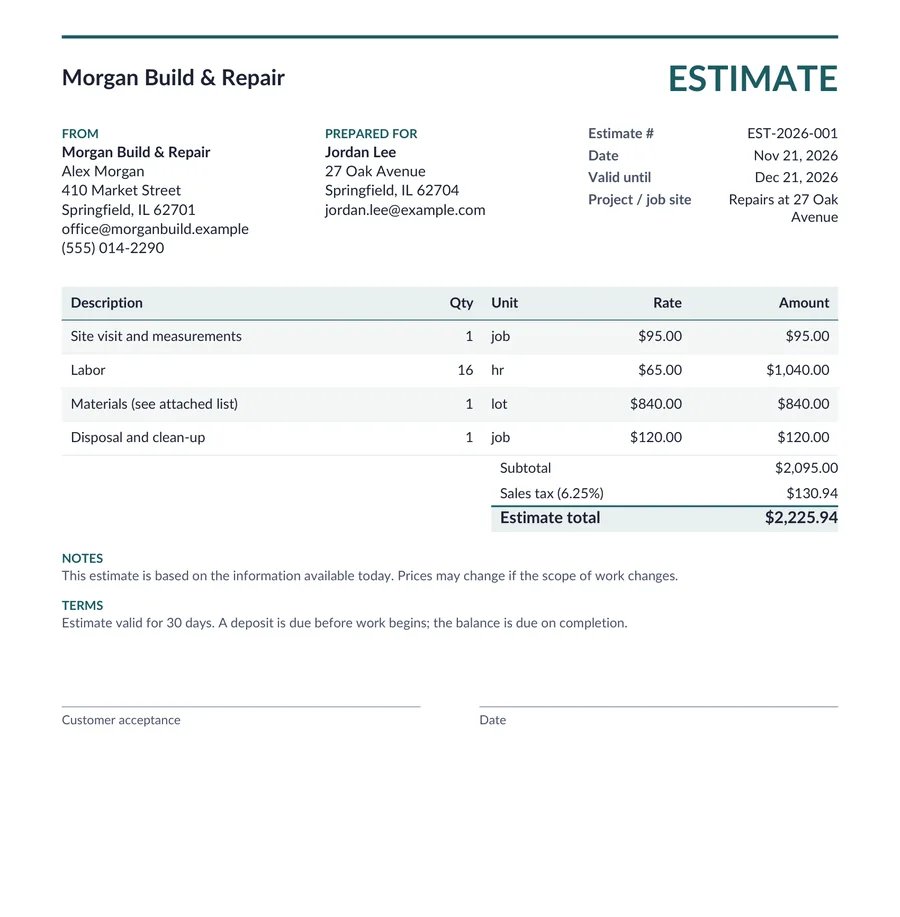
Split the price into lines a customer can check:
| Description | Qty | Unit | Rate | Amount |
|---|---|---|---|---|
| Demolition and haul-away | 1 | job | $450 | $450 |
| Porcelain floor tile, 12 × 24 in | 50 | sq ft | $6.50 | $325 |
| Thinset, grout, backer board | 1 | lot | $180 | $180 |
| Tile installation | 45 | sq ft | $12 | $540 |
| Vanity, faucet and mirror installation | 1 | job | $380 | $380 |
| Subtotal | $1,875 |
Materials show quantity and unit (sq ft, each, lot), labor shows hours or a per-unit rate. The 50 sq ft of tile against 45 sq ft of floor is the waste allowance; say so in the notes if a customer is likely to ask.
Then add tax if your state charges it on the items, any discount, and the total. If you ask for a deposit, show it as a separate line (“Deposit due on approval: $600”) so the customer sees both numbers.
4. What is not included
This is the section most estimates skip and most disputes start from. List the usual suspects for your trade:
- Permits and inspection fees (or say they are included)
- Repairs to anything found behind walls or under floors
- Painting, trim or patching outside the work area
- Materials the customer supplies, and what happens if they arrive late or damaged
One line, “Price assumes the subfloor is sound; repairs are extra at $85/hour plus materials”, saves an argument later.
5. Timeline, validity and changes
- Start and completion: a date or a range (“about 4 working days, starting within 2 weeks of approval”).
- Valid until: 30 days is common. Material prices move, and the date protects you.
- Changes: “Changes to the scope will be priced in a written change order before the work is done.”
An estimate is a best guess, so many contractors add a line on how far the final bill may differ, for example “The final invoice will not exceed this estimate by more than 10% without your approval.” If you want to commit to the exact price, send a quote instead.
6. Payment terms and how to say yes
Say what you want and when: deposit on approval, progress payment, balance on completion, and how they can pay. Then make saying yes easy: “To approve, sign below or reply to this email.” A signature line with a date helps on bigger jobs.
A one-page checklist
Before you send it, check that the estimate has:
- Your details, license number, the customer and job address
- Estimate number, date and valid-until date
- A scope a stranger could understand
- Materials and labor as separate lines with quantities
- Tax, discount, deposit and total
- What is not included
- Start and completion dates, and how changes are handled
- Payment terms and how to approve
Send it fast, follow up once
Customers who asked three contractors will often go with the first clear answer. Send the estimate as a PDF within a day or two of the visit, while they still remember you. If you hear nothing, one friendly follow-up a few days before the valid-until date is enough: “Just checking whether you had any questions about the bathroom estimate.”
When they say yes, don’t retype anything: turn the same document into the invoice, with the deposit already shown as paid.
Frequently asked questions
Is an estimate legally binding?
An estimate is an approximate price, not a fixed one, which is why it is called an estimate. If you want to commit to a price, send a quote. Either way, the agreement for the job is usually the signed contract or the customer's written approval.
How long should an estimate be valid?
Long enough for the customer to decide and short enough that your material prices still hold. Many trades use 30 days; use less when material prices move fast.
Should I charge for an estimate?
Most small jobs are estimated free because it wins work. For large or design-heavy jobs some businesses charge a fee and credit it against the job if the customer goes ahead. Say so before the visit.
How much detail should the line items have?
Enough that the customer can compare it with another estimate line by line: what, how many, the unit and the price. One line that says only "kitchen remodel" invites doubt.
Sources
- How to avoid a home improvement scam, Federal Trade Commission (consumer.ftc.gov)
- What is the difference between an estimate, bid, quote and proposal?, Procore
- Estimate, quote, bid and proposal: what is the difference?, FreshBooks
Photos are AI-generated illustrations; diagrams and tool screenshots are made from the PlanPrint tools. Something out of date or wrong? Tell us and we will correct it.