Estimate vs quote vs bid vs proposal
What separates an estimate, a quote, a bid and a proposal, when to send which, and what each document should contain. With a side-by-side comparison table.

In short
- An estimate is an approximate price based on what you know so far. It is usually understood as not final.
- A quote is a firmer price for a defined job, normally with a date until which the price holds.
- A bid is a price offered in response to a request, often in competition with other bidders (common in construction and public purchasing).
- A proposal is the broadest: it explains the approach, scope, schedule and price, and is often negotiated.
- People use these words loosely. What counts is what the document says: scope, price, validity date and what happens if the work changes.
All four documents tell a customer what a job will cost. They differ in how firm the price is and how much else the document explains. FreshBooks, Procore and GoCardless draw broadly the same lines, with one caveat: in daily business the words are often swapped. Procore points out that in construction, “quote” often means the price a contractor gets from a supplier for materials. The content of the document matters more than its title.
Side by side
| Estimate | Quote | Bid | Proposal | |
|---|---|---|---|---|
| Price | Approximate | Fixed for the defined scope | Fixed offer for the requested scope | Price plus explanation of options |
| Typical length | One page | One to two pages | Set by the request (forms, schedules) | Several pages |
| Validity date | Optional, often added | Usual | Set by the request | Usual |
| Sent when | Early, scope still open | Scope is clear | A buyer asks several suppliers to price the same job | The buyer wants to compare approaches, not only prices |
| Common in | Trades, repairs, renovation | Products, services, trades | Construction, public tenders | Agencies, consulting, larger projects |
Estimate
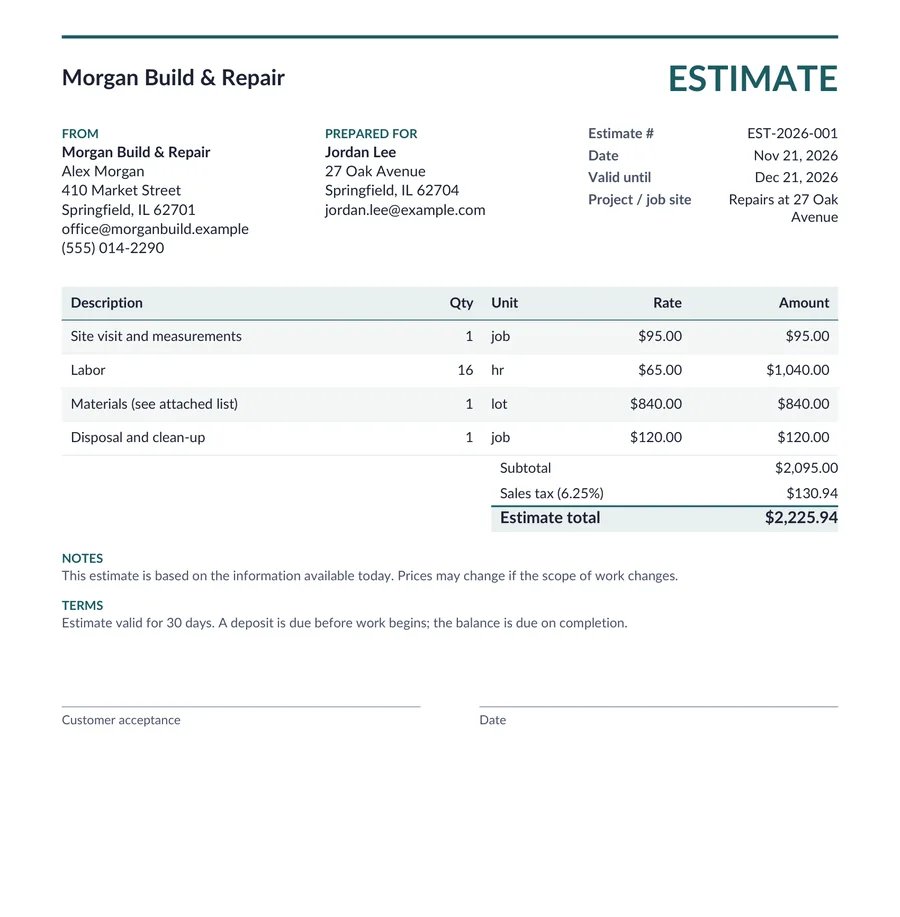
An estimate is your best price based on what you know. A roofer who has not yet seen under the old tiles, or a mechanic before the engine is opened, gives an estimate.
A good estimate lists the work in lines, shows the assumptions (“assumes the subfloor is sound”), and says what happens if they turn out wrong. Some trades add a range or a percentage the final price may differ by. Whatever you choose, write it on the estimate.
Quote
A quote is a price you stand behind for a defined scope. It normally carries a valid-until date, because your own costs change. If the customer accepts within that time, you do the listed work at that price. Anything outside the listed scope is extra, which is what a change order is for.
Bid
A bid answers a request: the buyer describes the job (often with drawings and specifications) and asks several contractors or suppliers to price it. Bids usually follow the buyer’s format and deadline. In public purchasing, a bid may have to follow strict rules on how it is submitted and opened, so read the request carefully.
Proposal
A proposal sells the approach as much as the price. It explains the problem, how you would solve it, the schedule, who does the work and what it costs, sometimes with options. Proposals are common where the buyer has not fixed the solution yet: design, marketing, software, consulting.
One job, three documents
A homeowner wants a leaking shower replaced. Here is how the same job looks as an estimate, a quote and a proposal:
Estimate, after a phone call and photos: “Remove and replace the shower tray, tiles and valve: $3,200 to $3,800, depending on the condition of the subfloor and the pipes behind the wall. Final price after inspection.”
Quote, after a site visit: “Remove the existing tray and wall tiles (3 walls, 75 sq ft), replace the valve, waterproof the walls and floor, fit a new tray and tile with your chosen 12 × 24 in porcelain. Fixed price $3,450. Excludes repairs to joists or subfloor if rot is found; those would be priced separately. Valid for 30 days.”
Proposal, when the customer is unsure what they want: two or three options with photos of past work: Option A, like-for-like replacement, $3,450. Option B, a curbless walk-in shower with a linear drain, $6,900. Each with a timeline, what is included, and the payment schedule.
Notice how each one is firmer than the last, and how the quote spells out the exclusions. That one sentence about the subfloor is what prevents an argument if the old tray hides a rotten floor.
Which one should you send?
- You cannot see everything yet (behind walls, under floors, inside an engine): an estimate, with the assumptions written down.
- The scope is clear and you are confident in your costs: a quote with a validity date.
- The customer sent you a request to price their specification: a bid, in their format and by their deadline.
- The customer has a problem, not a specification: a proposal that explains the options.
When in doubt, call it an estimate and make the assumptions explicit. It is easier to turn a well-explained estimate into a quote than to walk back a fixed price.
What every price document should include
Whatever the title, customers trust a price more when the document answers their questions before they ask:
- What is included, line by line, with quantities.
- What is not included. Permits, disposal, materials the customer supplies, repairs to hidden damage.
- Assumptions the price depends on.
- How long the price is valid.
- Payment terms: deposit, stages, and when the balance is due. See invoice payment terms.
- How to accept: a signature line, or “reply to this email to accept”.
- Timeline: when you can start and how long it takes.
The estimate template and quote template have fields for all of these, and once the customer accepts, the same lines become the invoice.
What happens after acceptance
Once the customer says yes, the paperwork usually continues like this:
Smaller jobs often skip the purchase order: a signed quote or a written “yes” is enough. Larger buyers usually require a PO number on your invoice, so ask for it before you start. The purchase order guide explains why.
Frequently asked questions
Is an estimate legally binding?
That depends on the wording and on the law where you work, so we cannot answer it for every case. In everyday use an estimate is understood as approximate. If you want it treated as approximate, say so on the document, and if the price is fixed, call it a quote and give a validity date.
How long should a quote be valid?
Long enough for the customer to decide, short enough that your costs do not move. 30 days is a common default; use less when material prices change quickly.
Should I charge for estimates?
Many trades give simple estimates for free and charge for detailed ones that need a site visit, drawings or testing. If you charge, say so before you visit, and consider crediting the fee against the job.
What is the difference between a quote and a proforma invoice?
A quote offers a price. A proforma invoice is sent when a sale is agreed but not yet invoiced, for example so the buyer can pay in advance or arrange import paperwork. It looks like an invoice but is marked proforma.
Sources
- Estimate, quote, bid and proposal: what is the difference?, FreshBooks
- What is the difference between an estimate, bid, quote and proposal?, Procore
- The difference between a quote and an estimate, GoCardless
Photos are AI-generated illustrations; diagrams and tool screenshots are made from the PlanPrint tools. Something out of date or wrong? Tell us and we will correct it.