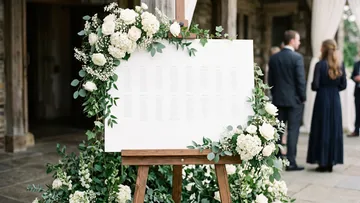
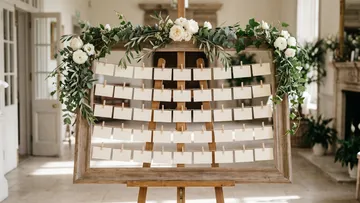
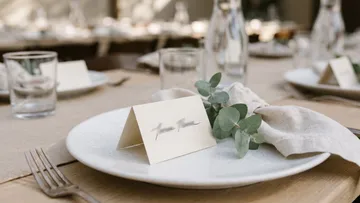
Seating chart sign wording: ideas and name rules
What to write on a wedding seating chart sign: heading ideas, how to list names, couples and plus-ones, by table or A to Z, and a proofreading checklist.

In short
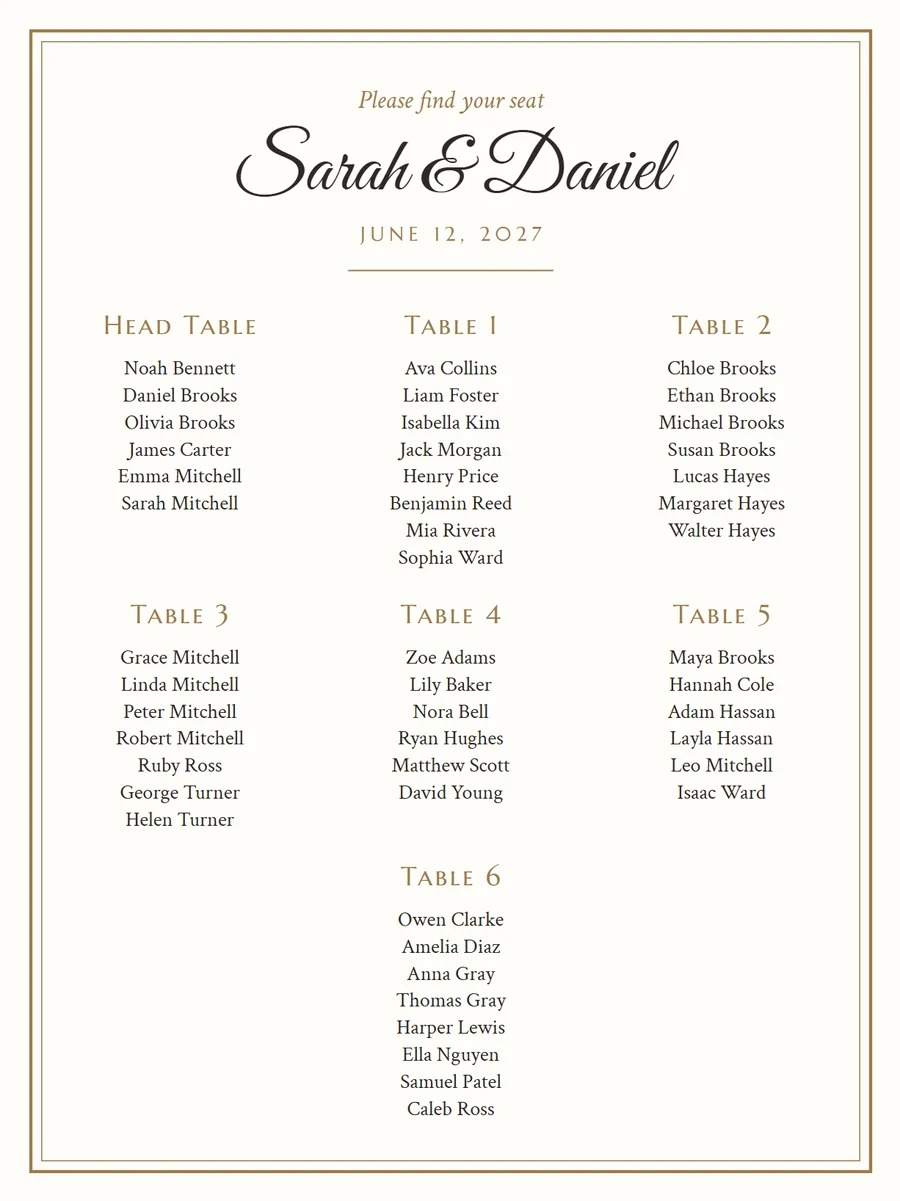
- A seating chart sign has three parts: a heading ("Please find your seat"), the couple's names and date, and the names with their tables.
- List full names and treat everyone the same way: if one guest gets a title, all guests get one.
- Sort A to Z by last name for more than about 80 guests; group by table for smaller weddings or when tables have names.
- Plan for readable type: guest names of about 20 pt or more, which an 18 × 24 in sign gives for up to about 120 to 150 guests.
A seating chart sign has one job: get every guest from the door to the right table in under a minute. The wording does most of that work. Here is what to put on it, line by line, with ideas for the heading and the rules for names that keep the sign easy to scan.
The three parts of the sign
- A heading that tells guests what to do: “Please find your seat”.
- Your names and the date: “Sarah & Daniel · June 12, 2027”. Optional, but it turns the sign into a keepsake.
- The names and tables, in columns, either grouped by table or A to Z.
A short line at the bottom is optional: “Dinner is served at 7” or “Thank you for celebrating with us”.
Heading ideas
Classic
- Please find your seat
- Please find your table
- Find your seat
- Seating chart
- Welcome. Please find your seat
Warm
- We saved you a seat
- So glad you’re here. Find your seat below
- Take a seat, you’re family now
- Thank you for being part of our day
- Come in, find your table, stay a while
Playful
- Good food, good company, your seat is below
- Find your seat, then find the dance floor
- You’re on the list. Find your table
- Sit back, relax, enjoy the show
- Table for you, right this way
Themed
- Travel: “Find your destination” with tables named after cities
- Garden: “Find your bloom” with tables named after flowers
- Books: “Find your chapter”
- Coffee shop: “Find your blend”
- Music: “Find your track”
Keep the heading under about six words. It is the largest text on the sign, and a long heading forces everything below it to shrink.
How to write the names
Zola’s place card guide puts the rule in one sentence: “The key with all of your place cards is to be consistent.” The same holds for the sign.
- Full names, first name first: “Anna Smith”. Guests scan for their own name, and full names avoid two Annas on one sign.
- Titles or none, for everyone: Zola notes you can use “each person’s full name without a title, especially for less formal celebrations”. If one guest gets “Dr.”, every guest gets a title.
- Couples with the same last name: one line, “Ben & Cara Jones”, is easiest to scan. Formal versions follow the guide’s rules (“Mr. and Mrs. Jones”).
- Couples with different last names: “Ben Lee & Cara Jones”, or two separate lines if you sort A to Z.
- Plus-ones: ask for the name with the RSVP. “Guest of Ben Lee” works if you can’t, and still tells the plus-one where to sit.
- Nicknames: use the name guests will look for. “Bob Taylor” if everyone calls him Bob.
By table or A to Z?
| Grouped by table | A to Z by last name | |
|---|---|---|
| Guests find their name by | Scanning tables | Jumping to their letter |
| Best for | Up to about 80 guests, named tables | Larger weddings |
| Shows who sits together | Yes | No |
| Name on two lines (couple) | One line per couple | Each person listed under their own letter |
Sorting by last name is what guests expect in an alphabetical list. The Knot’s seating etiquette guide covers who sits where; for the sign itself, the practical test is whether a guest finds their name before the person behind them gets impatient.
Table names and numbers
“Table 7” is the fastest to find. If you name your tables (cities, flowers, places you have traveled), print the same name on the table card and add a number in smaller type (“Lisbon · 7”). Guests remember numbers more easily than names when they walk into the room.
The head or sweetheart table usually does not appear on the sign: everyone knows where the couple sits. Wedding party members seated there still need to find their name, so either list “Head table” as its own group or tell them in advance.
Make it readable from a distance
A common signage rule of thumb, from Signs.com, is to “increase the letter height by 1 inch” for every 10 feet of viewing distance. Guests stand close to a seating chart, usually within 2 to 4 feet, so guest names of about 20 pt or more read comfortably. The heading can be three or four times that size.
That is why the number of guests decides the sign size: 18 × 24 inches keeps names at about 21 pt for up to about 120 to 150 guests, and larger weddings need 24 × 36 inches or two signs. See how big a seating chart sign should be for the measured sizes.
Proofread before you print
- Every name spelled the way the guest spells it (ask, don’t guess)
- No guest missing, no guest listed twice
- Same name format on every line
- Table numbers match the floor plan and the table cards
- Late RSVP changes made
- Date and names in the heading are right
Print a letter-size section of the sign at actual size and read it from three or four feet away. If you have to step closer, the names are too small.
Frequently asked questions
Should the seating chart say "Please find your seat" or "Please find your table"?
"Find your table" is more accurate when guests choose their own chair at the table. Use "find your seat" when place cards mark each chair.
Do I write "and Guest" for plus-ones?
You can, but it is warmer to ask for the guest's name with the RSVP and print it. Zola's place card guide suggests asking for full names rather than writing "Mr. X's Guest".
Should I include titles like Mr. and Mrs.?
Titles are optional and suit formal weddings. Most seating charts skip them, which also avoids guessing anyone's title. Whatever you choose, apply it to every name.
How do I list a family on the seating chart?
List each person, or use one line for the family when they sit together: "The Rivera family". Choose one approach for the whole sign so guests know where to look.
Sources
- What to write on wedding place cards, Zola
- Wedding seating chart etiquette, The Knot
- Signage 101: letter height visibility, Signs.com
Photos are AI-generated illustrations; diagrams and tool screenshots are made from the PlanPrint tools. Something out of date or wrong? Tell us and we will correct it.